

Meta’s advertising ecosystem is going through one of its biggest transformations and most marketers still aren’t aware of what’s powering it. The change begins with Meta Andromeda, a next-generation retrieval engine redefining how the platform matches people with ads. Instead of relying on granular audience targeting, Andromeda increasingly uses the creative itself as a core signal.
This shift matters for anyone using Advantage+, Meta’s automated campaign framework. Brands willing to adapt can unlock major performance gains. Those who cling to complex targeting structures may see rising costs and unpredictable delivery.
What Exactly Is Meta Andromeda?
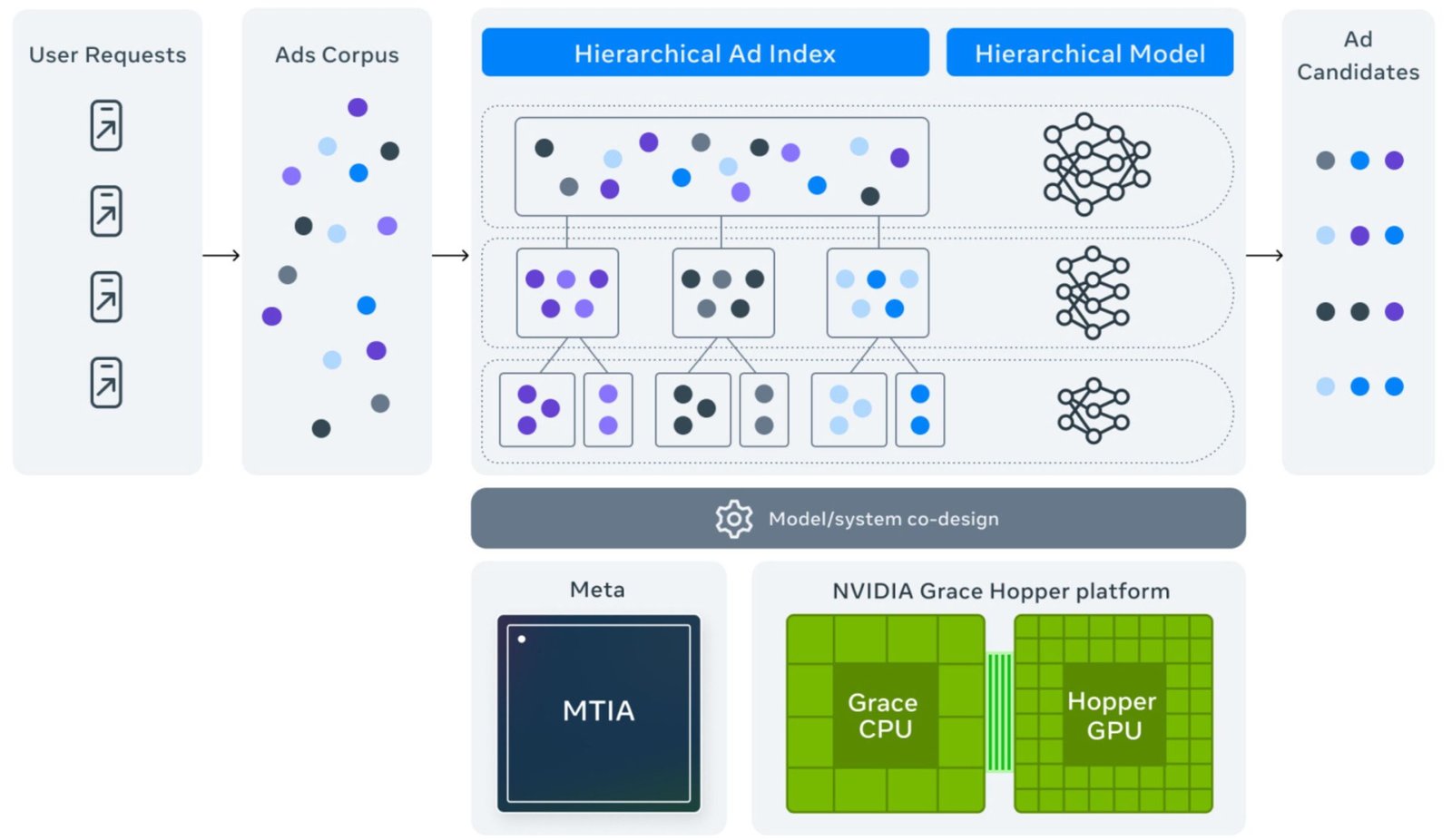
Image Credit: Meta Engineering Blog. Used for educational commentary purposes only. All rights belong to Meta Platforms, Inc.
According to the team behind it at Meta Engineering, Andromeda is a “next-gen personalized ads retrieval engine” operating before ranking and auction. Its job:
From millions of possible ad candidates → select the few thousand most relevant → in real time.
The scale behind that task is enormous. As automation and generative creative tools increase ad volume, Meta needed a more intelligent and faster system to pick the best matches.
Andromeda does that using:
Deep neural retrieval networks
Hierarchical indexing for faster elimination
Elastic compute models that scale instantly
Meta explains these advancements in its official engineering deep dive on the Andromeda AI architecture, where the company outlines faster retrieval and higher quality ad selection, improving overall performance across Meta’s auction ecosystem.
Why This Change Matters: Creative Becomes the Targeting
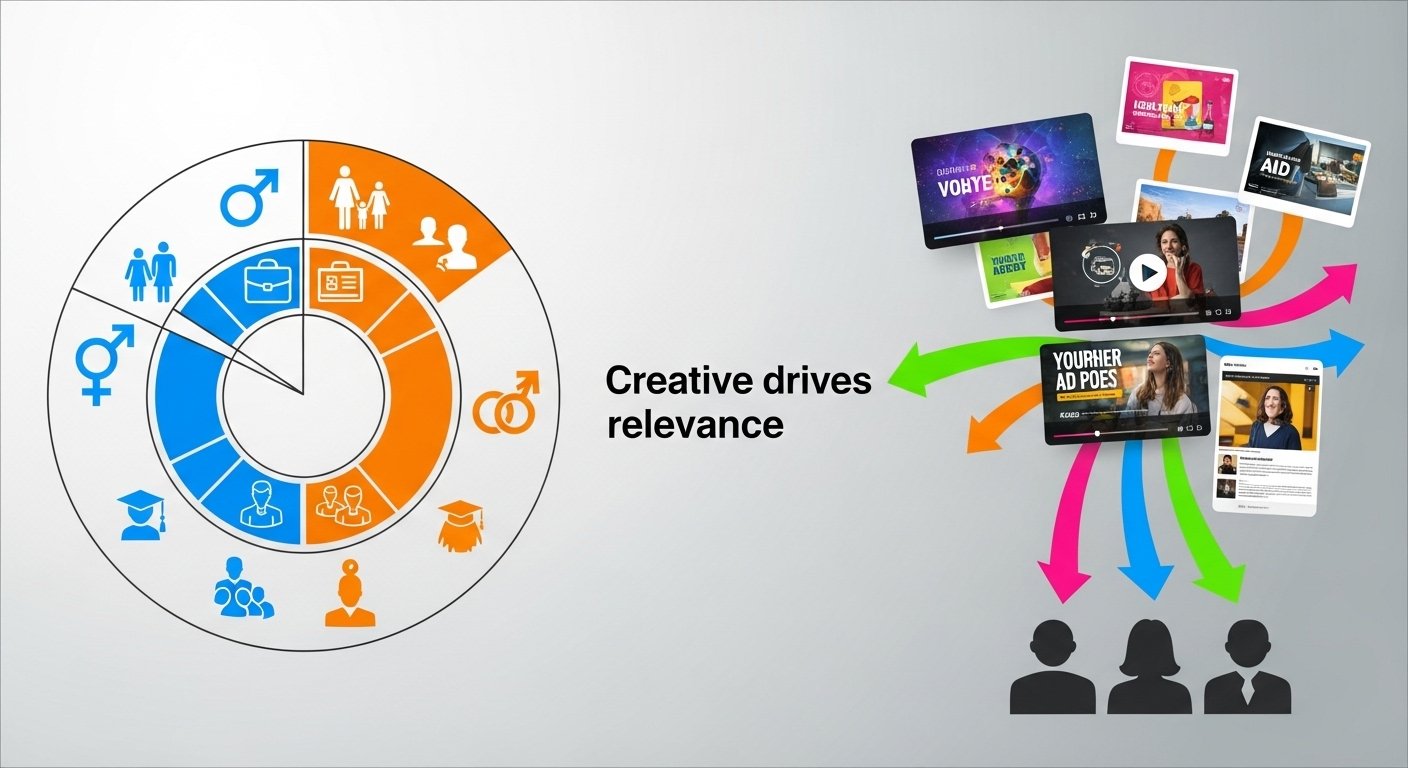
For years, advertisers were trained to build granular audiences. Now, the opposite is true:
Broad targeting performs better
Fewer ad sets outperform fragmentation
Creative variety drives results not audience knobs
Every scroll, pause, click, save, and purchase provides deeper insight into what resonates and why. And Andromeda re-activates those signals instantly.
This shift puts creative strategy front-and-center in media buying. In other words:
Targeting now happens inside the creative
Want to dive deeper into automation strategies?
Check out more insights in our Digital Marketing Guides
What Performance Data Shows So Far
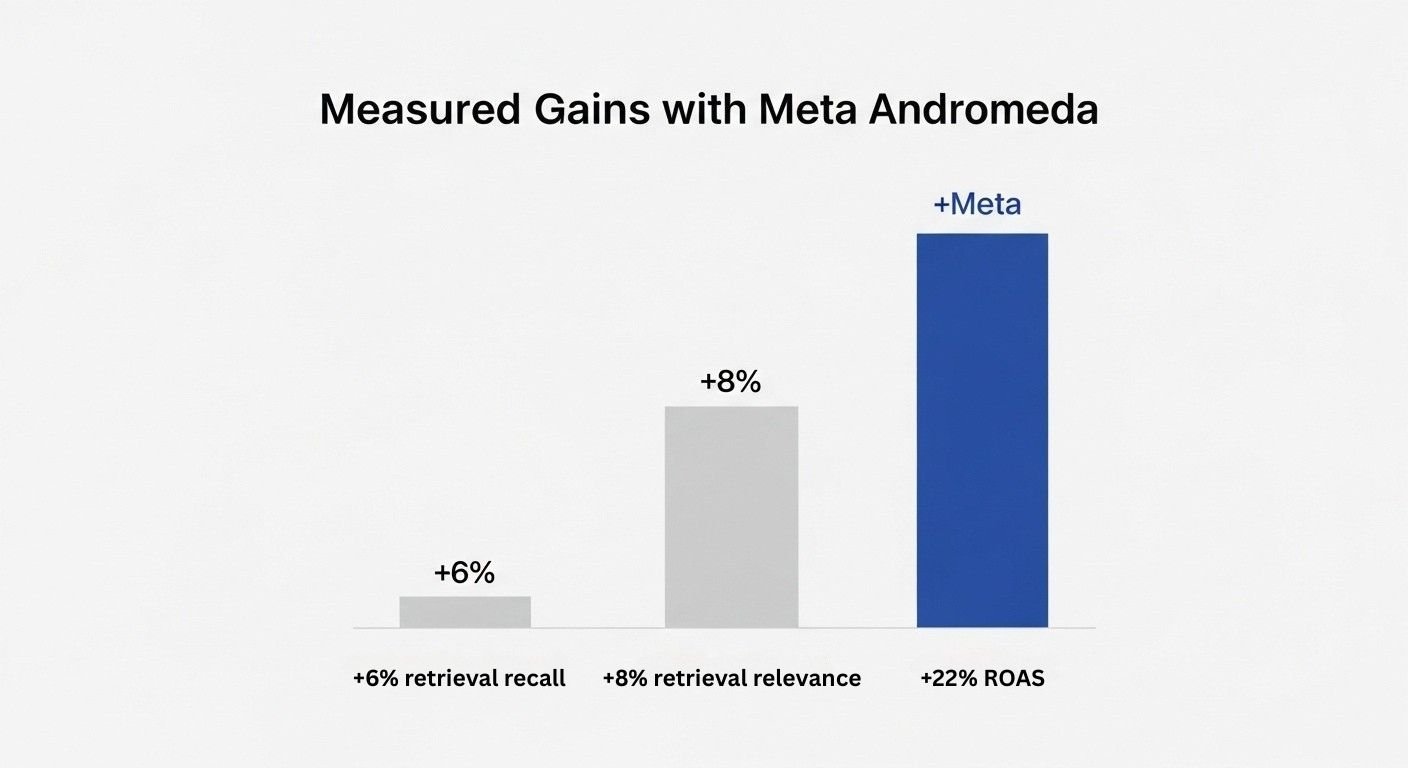
Early Meta engineering reports indicate:
+6% improvement in retrieval recall
+8% improvement in ad relevance + quality
+22% stronger ROAS when paired with Advantage+ creative tools
Industry practitioners often see even stronger gains once campaigns are simplified:
Agency case studies report:
10–20% reduction in CPMs
20–35% lower CPA
Better budget distribution across creatives
Less over-spend on one “winner” ad
To unlock the gains, the system needs clean data and lots of creative diversity.
Signals Matter More Than Segments
Andromeda heavily depends on signal fidelity. Key success factors include:
Accurate server-side signals
Pixel duplication cleaned up correctly
Conversion API (CAPI) connected and stable
Full-funnel event optimization
(not just last-click events)
If signals are weak, Andromeda can’t predict intent effectively — and performance suffers.
Good signals = lower cost.
Bad signals = volatility.
Advantage+ and Andromeda: How They Work Together
Some marketers still think Andromeda is a product to toggle on. It isn’t.
Advantage+ → front-end automation system
Andromeda → back-end retrieval brain
Andromeda supplies the most relevant ads to Advantage+, helping:
Shopping campaigns diversify creative shown to each user
Lead gen campaigns find higher-intent prospects
App campaigns forecast install → engagement → revenue pathways
Automation becomes more powerful and less optional as the retrieval engine improves.
Practical Use Case Across Verticals
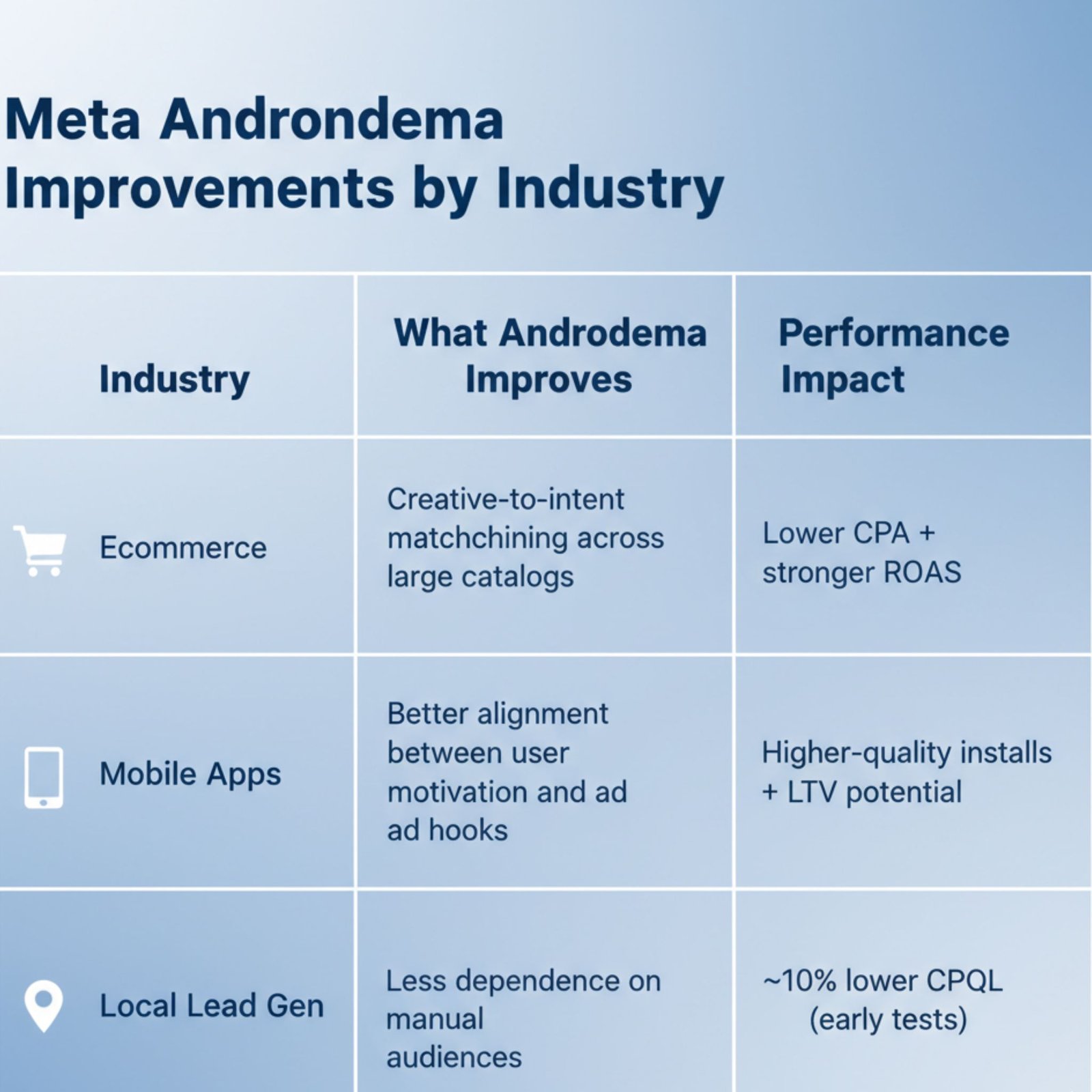
Where results struggle:
Limited creative volume
Outdated targeting structures
Incomplete conversion tracking
Winning requires a mindset shift.
What the Industry Is Saying
Analysts and performance leads agree on two challenges:
- Creative volume expectations are rising
Not just variations — entirely new concepts. - Old targeting habits must be retired
Let the machine do the matching.
Jon Loomer captured this perfectly in his analysis of modern automation strategy
The payoff is real: greater efficiency, faster scale, more consistent delivery.
Privacy + Transparency Considerations
Meta continues expanding transparency and disclosure including:
Mandatory labels for AI-generated ads
Reporting enhancements for users and regulators
More details can be found in Meta’s official policy standards for AI-generated advertising transparency, which outline requirements for advertisers globally.
Compliance remains a moving target as legislation evolves globally.
How Advertisers Should Respond Immediately
A proven optimization playbook is emerging:
Consolidate: One campaign → one ad set
Go broad: Avoid narrow audiences
Diversify: 8–12+ unique creative concepts per audience
Strengthen signals: CAPI + deduplication + deeper conversion mapping
Simplify your structure.
Expand your creative library.
Let the system learn.
The Future: Andromeda Is Just the Beginning
Meta hints at a long roadmap ahead including:
More Advantage+ expansion
Deeper integration of generative tools
Stronger real time learning systems
This won’t be a short-term update it’s an architectural evolution.
Automation isn’t removing strategy.
It’s changing where strategy lives.
The Core Takeaway
Those who embrace Meta Andromeda’s model:
✅ Scale more efficiently
✅ Maintain advantage with rising competition
✅ Achieve better alignment between creative + intent
Those who fight automation:
⚠ Pay more
⚠ Lose relevance
⚠ Get outperformed by smarter systems
The message for performance marketers is clear:
Creative is your new targeting.
Meta Andromeda is already enforcing that future.
Stay tuned we’ll continue publishing deep-dive breakdowns of Meta’s latest AI-driven performance technologies, including new Andromeda updates as they roll out. Follow our Digital Marketing insights to stay ahead of the curve.